Imagine a robot assembling a car inside a manufacturing plant. It follows instructions, detects objects and performs precise movements. Now imagine an AI-powered application analysing thousands of medical images to identify patterns that may help doctors make better decisions.
Both examples represent exciting developments in modern technology, but they involve different areas of engineering.
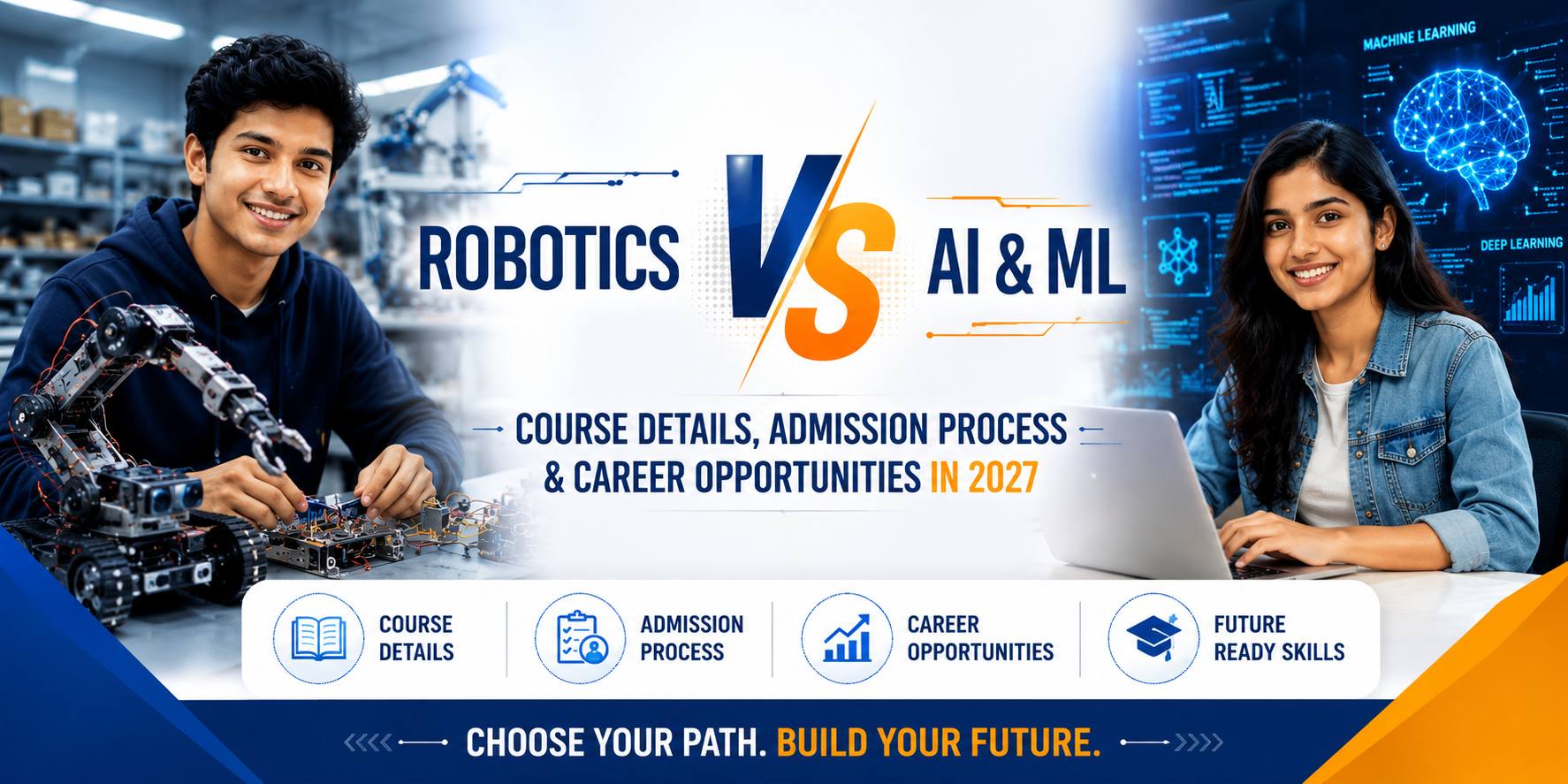
Robotics focuses on designing and developing machines that can interact with the physical world. Artificial Intelligence and Machine Learning (AI & ML) focus on creating computer systems that can learn from data, recognise patterns and make intelligent decisions.
For students planning engineering admission in 2027, choosing between these two specialisations can be challenging. Both offer opportunities to work with emerging technologies, but their subjects, practical applications and career paths are not the same.
So, Robotics vs AI & ML: which course should you choose after Class 12? Let's explore the differences before making that decision.
1. Robotics Engineering: Turning Technology into Physical Machines
Robotics Engineering brings together mechanical engineering, electronics, computer programming and control systems to create machines that can perform specific tasks.
A robot is not simply a machine that moves. It may contain sensors, motors, controllers and software that allow it to respond to its surroundings.
Robotics is used in automobile manufacturing, industrial automation, healthcare equipment, warehouse operations, agriculture, space exploration and other technical applications.
For example, an industrial robotic arm can perform repetitive welding operations, while an autonomous mobile robot can move materials inside a warehouse.
What Will You Study in Robotics Engineering?
A Robotics-focused engineering curriculum may include:
-
Engineering Mathematics
-
Basic Mechanical Engineering
-
Electrical and Electronics Engineering
-
Engineering Mechanics
-
Sensors and Actuators
-
Microprocessors and Microcontrollers
-
Robotics Fundamentals
-
Control Systems
-
Embedded Systems
-
Robot Kinematics and Dynamics
-
Industrial Automation
-
Computer-Aided Design
-
Programming for Robotics
Depending on the programme, students may also receive exposure to autonomous systems, computer vision, intelligent robotics and automation technologies.
The practical side: Robotics students often work on hardware-based assignments, robotic models, electronic circuits, sensor integration and automation projects. This makes laboratory work an important part of learning.
2. AI & ML: Teaching Computers to Learn and Make Decisions
Artificial Intelligence is the field of developing computer systems that can perform tasks associated with intelligent behaviour. Machine Learning is a branch of AI that enables systems to identify patterns in data and improve their performance through learning.
Think about how a video platform recommends content based on viewing habits. Or how a navigation application estimates traffic conditions and suggests alternative routes. These are examples of technologies that use data-driven and intelligent computing techniques.
AI & ML has applications in healthcare, banking, education, manufacturing, retail, agriculture, cybersecurity and many other sectors.
What Will You Study in AI & ML?
A typical AI & ML engineering curriculum may include:
-
Programming Languages
-
Data Structures and Algorithms
-
Engineering Mathematics
-
Probability and Statistics
-
Database Management Systems
-
Artificial Intelligence Fundamentals
-
Machine Learning
-
Deep Learning
-
Neural Networks
-
Natural Language Processing
-
Computer Vision
-
Data Analytics
-
Big Data Technologies
The practical side: Students may develop prediction models, build intelligent applications, experiment with datasets and create projects involving image recognition, language processing or recommendation systems.
3. Robotics vs AI & ML: Where Do They Actually Differ?
The easiest way to understand the difference is to look at what each field creates.
Robotics engineers develop machines that can perform physical operations. AI & ML engineers develop intelligent systems that can analyse information and generate predictions or decisions.
However, the two fields can work together. An intelligent robot may use AI to recognise objects, understand its environment and decide how to respond.
|
Area |
Robotics |
AI & ML |
|
Main Objective |
Designing and controlling robotic machines |
Developing intelligent and learning-based systems |
|
Core Subjects |
Mechanics, electronics, sensors and control systems |
Programming, mathematics, statistics and algorithms |
|
Hardware Knowledge |
Important |
Depends on the application |
|
Programming |
Used for robot control and automation |
Used for data processing and model development |
|
Practical Projects |
Robotic arms, mobile robots and automation systems |
Prediction models, intelligent applications and data analysis |
|
Application Areas |
Manufacturing, healthcare, logistics and automation |
Finance, healthcare, education, technology and research |
One important point: Robotics is not limited to mechanical components, and AI & ML is not limited to software applications. Modern robotics increasingly uses intelligent algorithms, while AI systems may interact with physical devices.
4. Eligibility for Robotics and AI & ML Admission 2027
Students interested in either specialisation should first understand the academic eligibility requirements.
For undergraduate engineering programmes, the general requirements may include:
-
Completion of Class 12 or an equivalent qualification from a recognised board.
-
Physics and Mathematics as prescribed subjects.
-
Additional subjects such as Chemistry, Computer Science or other approved alternatives, depending on the admission rules.
-
Minimum qualifying marks as specified by the relevant institution or admission authority.
-
Entrance examination requirements, wherever applicable.
Students should not assume that every institution follows identical eligibility conditions. Check the official course-specific admission notification for the 2027 academic session.
5. How to Apply for Engineering Admission in 2027
Whether you select Robotics or AI & ML, the admission process generally involves several stages. The exact procedure depends on the institution and the applicable admission route.
First, identify the programme. Check whether the institution offers Robotics Engineering, Robotics and Automation, AI & ML or a related specialisation.
Next, review the eligibility criteria. Confirm the required Class 12 subjects, minimum marks and any additional conditions.
Check the admission route. Some institutions may consider entrance examination scores, while others may follow qualifying examination-based selection or approved counselling procedures.
Submit the application. Complete the prescribed application form and provide the required academic and personal details.
Complete verification and selection. Follow the institution's instructions for counselling, document verification or other selection stages.
Confirm your seat. Complete the required admission formalities and fee payment within the official timeline.
Students should keep their Class 10 and Class 12 mark sheets, photographs, identity documents and other prescribed certificates ready.
6. Career Opportunities After Robotics Engineering
If you enjoy building machines, experimenting with electronic components and understanding how automated systems work, Robotics can lead to several interesting career paths.
Depending on your skills, projects and practical experience, you may explore roles such as:
Robotics Engineer: Designs, develops, tests and maintains robotic systems.
Automation Engineer: Works on automated processes used in manufacturing and industrial operations.
Control Systems Engineer: Develops systems that regulate the movement and operation of machines.
Embedded Systems Engineer: Works with hardware and software integrated into electronic devices.
Robotics Software Developer: Develops software used to control and coordinate robotic operations.
Mechatronics Engineer: Combines mechanical, electronic and computing technologies to develop integrated systems.
Industrial Robotics Specialist: Supports the installation, programming and maintenance of industrial robots.
Robotics graduates may find opportunities in manufacturing, automotive companies, automation firms, research organisations and technology-driven industries.
7. Career Opportunities After AI & ML
AI & ML can be a suitable choice for students who enjoy programming, mathematical problem-solving and working with data.
Some career options include:
-
AI Engineer: Develops applications using artificial intelligence techniques.
-
Machine Learning Engineer: Builds, trains and improves machine learning models.
-
Data Scientist: Uses statistical and computational methods to analyse complex datasets.
-
Computer Vision Engineer: Develops systems that interpret images and videos.
-
NLP Engineer: Works on applications that process and understand human language.
-
AI Application Developer: Integrates AI capabilities into software products.
-
Research Associate: Supports research and experimentation in AI-related areas.
The opportunities available depend on the graduate's technical knowledge, project experience and ability to work with relevant tools and technologies.
8. Can Robotics and AI & ML Work Together?
Absolutely. In fact, the combination of robotics and artificial intelligence is helping develop more advanced automated systems.
Consider an autonomous warehouse robot. Its motors and mechanical components allow it to move. Sensors help it detect obstacles, while AI-based technologies can support object recognition, navigation and decision-making.
Here are some examples of how the two fields connect:
-
Smart Manufacturing: AI can analyse production information while robots perform repetitive manufacturing operations.
-
Healthcare Robotics: Intelligent systems can support robotic equipment used in medical environments.
-
Autonomous Vehicles: Sensors, control systems and AI techniques work together to support navigation and object detection.
-
Agricultural Automation: Robotic equipment can perform field operations while intelligent systems analyse crop-related information.
-
Warehouse Management: Robots move goods while software helps coordinate routes, inventory and operational decisions.
This overlap creates opportunities for students who want to explore more than one area of technology.
9. Robotics vs AI & ML: Which One Should You Choose?
There is no single answer for every student. Your choice should depend on what you enjoy studying and the kind of problems you want to solve.
Robotics may suit you if:
-
You enjoy electronics, mechanical systems and programming.
-
You want to build machines that perform real-world tasks.
-
You are interested in sensors, automation and control systems.
-
You prefer practical projects involving hardware and software.
AI & ML may suit you if:
-
You enjoy programming and mathematical problem-solving.
-
You are interested in data, algorithms and intelligent applications.
-
You want to explore machine learning and predictive technologies.
-
You enjoy developing software-based solutions.
If you like both areas, explore interdisciplinary subjects such as intelligent robotics, autonomous systems, computer vision and robotics software.
10. What Should You Check Before Selecting a College?
A course title alone does not tell you how much practical knowledge you will gain. Before choosing an institution for 2027 admission, examine the academic and technical environment carefully.
Use these points as a checklist:
-
Programme Structure: Check the actual syllabus and whether it includes the subjects you want to study.
-
Laboratory Facilities: For Robotics, review robotics, electronics and automation laboratories. For AI & ML, check computing facilities and access to relevant software.
-
Faculty Expertise: Explore faculty qualifications, academic backgrounds and research interests.
-
Practical Projects: Look for opportunities to build robots, develop applications and participate in technical projects.
-
Internship Exposure: Check whether students receive opportunities for industry training and internships.
-
Industry Interaction: Workshops, seminars, competitions and technical collaborations can add practical value.
-
Placement Information: Review verified placement records, job profiles and recruiter details.
Students exploring engineering education options in West Bengal can visit the official JIS College of Engineering website for institutional information. Confirm the availability of the relevant programme, course structure and 2027 admission requirements directly with the institution.
Frequently Asked Questions (FAQs)
1. Which is better, Robotics or AI & ML?
Both fields offer different learning experiences. Robotics is focused on machines, electronics and automation, whereas AI & ML focuses on intelligent computing and data-driven systems. The better choice depends on your interests.
2. Can I pursue Robotics Engineering after Class 12?
Yes. Students who meet the prescribed eligibility requirements can apply for relevant undergraduate Robotics or Robotics and Automation programmes after Class 12.
3. Is coding necessary for Robotics Engineering?
Yes. Programming is useful for controlling robots, integrating sensors, developing embedded applications and automating machine operations.
4. Does AI & ML require strong mathematical knowledge?
Yes. Mathematics, probability and statistics are important for understanding machine learning algorithms, model development and data analysis.
5. What is the difference between Robotics and Artificial Intelligence?
Robotics focuses on designing and operating physical machines, while Artificial Intelligence focuses on developing systems that can perform intelligent tasks. AI can also be integrated into robots.
6. What jobs can I get after studying Robotics?
Depending on your skills and experience, you may explore roles such as Robotics Engineer, Automation Engineer, Embedded Systems Engineer, Control Systems Engineer and Mechatronics Engineer.
7. Can AI & ML students work in robotics-related industries?
Yes. AI & ML graduates can work on areas such as computer vision, intelligent automation, autonomous systems and machine learning applications used in robotics.
8. What should I consider before applying for engineering admission in 2027?
Check course availability, eligibility, entrance requirements, curriculum, laboratory facilities, faculty expertise, internship opportunities and verified placement information.
Conclusion
Robotics and AI & ML represent two exciting directions in modern engineering. One focuses on creating machines that can interact with the physical world, while the other develops intelligent systems that can learn from information and support decision-making.
For students planning admission in 2027, the decision should go beyond choosing the most popular technology. Think about whether you enjoy building machines, developing software, analysing data or combining these skills to solve practical problems.
Explore the curriculum, understand the admission requirements and choose an engineering specialisation that matches your interests. A strong foundation, practical experience and continuous learning will matter throughout your technology career.