Choosing an engineering branch after Class 12 is an important decision for students planning to build a career in technology. With several B.Tech specialisations available, it is natural to feel confused about which course offers the right combination of academic interest, practical learning and future career opportunities.
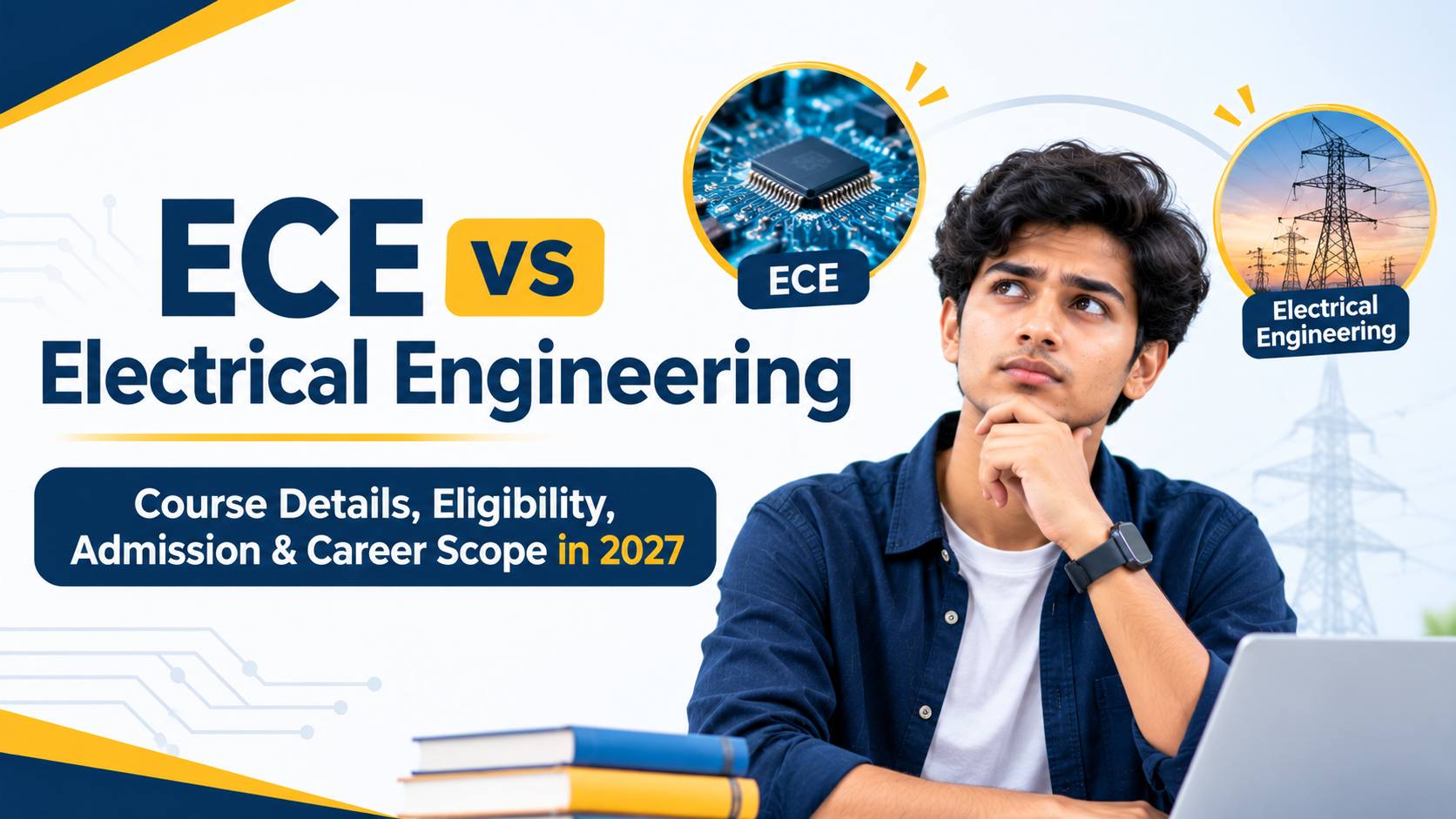
Two engineering branches that students often consider are Electronics and Communication Engineering (ECE) and Electrical Engineering. Both are connected to technology, electronics and modern engineering systems, but they focus on different areas of study and application.
ECE primarily deals with electronic circuits, communication systems, semiconductor technology, signal processing and embedded systems. Electrical Engineering focuses more on electrical power, machines, energy systems, control systems and electrical infrastructure.
If you are planning to apply for B.Tech admission in 2027, understanding the difference between these branches can help you make a more informed decision.
In this guide, we will explore ECE vs Electrical Engineering, including course details, eligibility criteria, admission procedures, important subjects, career opportunities and the factors students should consider before choosing a branch.
What Is Electronics and Communication Engineering (ECE)?
Electronics and Communication Engineering is an undergraduate engineering discipline focused on the design, development, testing and application of electronic devices and communication technologies.
The course helps students understand how electronic components and systems work, how information is transmitted and received, and how hardware and software interact in modern devices.
ECE is relevant to several technology areas, including telecommunications, semiconductor systems, embedded technology, networking, signal processing and electronics manufacturing.
Important subjects in ECE may include:
-
Electronic Devices and Circuits
-
Digital Electronics
-
Analog Electronics
-
Signals and Systems
-
Digital Signal Processing
-
Communication Systems
-
Microprocessors and Microcontrollers
-
Electromagnetic Theory
-
Embedded Systems
-
VLSI Design
-
Computer Networks
-
Control Systems
The exact subjects and electives depend on the university curriculum and the applicable academic regulations.
What Do ECE Students Learn?
Students studying ECE develop an understanding of electronic hardware, communication networks and signal-processing techniques. Practical learning may involve circuit design, electronics laboratories, microcontroller-based projects, simulation tools and communication experiments.
For example, students may work on projects involving sensor-based systems, wireless communication, embedded devices or electronic circuit applications.
These learning experiences can help prepare graduates for roles in electronics, telecommunications, semiconductor-related work, embedded systems and other technology sectors.
What Is Electrical Engineering?
Electrical Engineering is an engineering discipline concerned with the generation, transmission, distribution, control and application of electrical energy.
It also covers electrical machines, power electronics, automation, electrical equipment and systems used in industries, infrastructure and energy networks.
Electrical Engineering plays an important role in power plants, renewable energy installations, manufacturing facilities, transportation systems and industrial operations.
Important subjects in Electrical Engineering may include:
-
Electrical Circuit Theory
-
Electrical Machines
-
Power Systems
-
Power Electronics
-
Electrical Measurements
-
Control Systems
-
Power Generation and Distribution
-
Electrical Drives
-
Switchgear and Protection
-
Renewable Energy Systems
-
High Voltage Engineering
-
Electrical Machine Design
The subjects and their depth may vary depending on the institution and programme structure.
What Do Electrical Engineering Students Learn?
Electrical Engineering students learn how electrical systems are designed, operated, maintained and controlled. They study the principles behind motors, generators, transformers, electrical networks and power distribution systems.
Practical learning may include electrical machine laboratories, power system experiments, circuit testing, electrical measurements and industrial automation projects.
This knowledge can prepare graduates for opportunities in power generation, electrical equipment, industrial automation, renewable energy and infrastructure-related sectors.
ECE vs Electrical Engineering: Key Differences
Although both branches share some foundational engineering subjects, their main areas of specialisation are different.
|
Comparison Factor |
Electronics and Communication Engineering |
Electrical Engineering |
|
Main Focus |
Electronics, communication and electronic systems |
Electrical energy, machines and power systems |
|
Core Area |
Electronic circuits and signal transmission |
Generation, transmission and distribution of electricity |
|
Important Subjects |
Digital electronics, communication systems, VLSI and embedded systems |
Electrical machines, power systems and power electronics |
|
Practical Learning |
Circuit design, microcontrollers and communication experiments |
Electrical machines, power systems and electrical equipment |
|
Technology Applications |
Telecommunications, semiconductor systems and embedded devices |
Power infrastructure, industrial systems and renewable energy |
|
Industry Areas |
Electronics, telecom, semiconductor and embedded technology |
Energy, manufacturing, infrastructure and automation |
|
Career Direction |
Electronics and communication-related technical roles |
Electrical and power-related engineering roles |
The main difference in ECE vs Electrical Engineering is the type of engineering systems students learn to design and work with. ECE is more focused on electronic devices and information communication, while Electrical Engineering is more focused on electrical energy and power applications.
ECE vs Electrical Engineering: Course Duration and Academic Structure
Both ECE and Electrical Engineering are commonly offered as four-year undergraduate B.Tech programmes in India.
The academic structure generally includes:
First Year: Engineering Fundamentals
Students usually study foundational subjects such as engineering mathematics, physics, basic electrical or electronics concepts, programming and engineering mechanics, depending on the curriculum.
Second Year: Core Engineering Subjects
Students begin studying branch-specific concepts. ECE students explore electronic circuits, digital systems and signals, while Electrical Engineering students study electrical circuits, machines and measurements.
Third Year: Advanced Technical Learning
Students study more specialised subjects and may participate in laboratory work, technical projects, workshops and internships.
Fourth Year: Projects and Specialisation
The final year generally focuses on advanced electives, project work, technical applications and preparation for employment or higher education.
Students should check the latest university syllabus to understand the actual semester-wise curriculum for the 2027 admission session.
ECE vs Electrical Engineering: Eligibility Criteria for 2027 Admission
Students planning to pursue either branch should understand the general eligibility requirements for undergraduate engineering admission.
In most B.Tech admission pathways, candidates are expected to have completed Class 12 or an equivalent examination with Physics and Mathematics, along with other subjects specified by the relevant institution or admission authority.
Common eligibility considerations include:
-
Completion of Class 12 from a recognised board or an equivalent qualification.
-
Physics and Mathematics as required subjects.
-
An additional eligible subject, as specified by the applicable admission rules.
-
Meeting the minimum qualifying marks prescribed by the institution or admission authority.
-
Fulfilling any applicable entrance examination or counselling requirements.
Important: Eligibility conditions can differ between universities, entrance examinations and admission routes. Students applying for B.Tech admission in 2027 should check the latest official admission notification before submitting an application.
B.Tech Admission Process 2027: ECE and Electrical Engineering
The admission process for ECE and Electrical Engineering generally follows the undergraduate engineering admission framework of the institution or the relevant admission authority.
Students should understand the following steps before applying.
Step 1: Check Course Availability
First, visit the official website of the college or university and check whether ECE and Electrical Engineering are available for the 2027 admission session.
Review the course structure, eligibility requirements, approved intake and other programme information.
Step 2: Review Entrance Examination Requirements
Depending on the institution and admission route, candidates may need to qualify through an applicable engineering entrance examination.
Students should check the relevant examination requirements, registration dates, eligibility rules and selection criteria.
Step 3: Complete the Application Form
Candidates should complete the application process through the official admission portal or the prescribed application channel.
Provide accurate academic and personal information and review the details before submitting the form.
Step 4: Participate in Counselling or Selection
Depending on the admission route, selection may involve entrance examination scores, counselling, merit-based assessment or other prescribed procedures.
Candidates should follow the official instructions and deadlines.
Step 5: Complete Document Verification
Students may be required to submit documents such as:
-
Class 10 mark sheet and certificate
-
Class 12 mark sheet or qualifying examination details
-
Entrance examination scorecard, where applicable
-
Identity proof
-
Recent photographs
-
Category certificate, if applicable
-
Other documents specified by the admission authority
Step 6: Confirm Admission
After receiving an admission offer, candidates should complete the prescribed fee payment and document verification process within the given deadline.
Admission 2027 reminder: Examination dates, application deadlines, counselling schedules, fees and seat availability should be confirmed through official announcements. Do not rely on previous-year schedules as confirmed dates for 2027.
Career Opportunities After ECE
ECE graduates can explore career opportunities across electronics, communication, embedded technology and related technical industries.
Some possible career paths include:
1. Electronics Engineer
Electronics engineers work with electronic circuits, components and systems. Their responsibilities may include design, testing, troubleshooting and product development.
2. Embedded Systems Engineer
Embedded systems engineers work on hardware and software combinations used in devices such as industrial equipment, consumer electronics and connected systems.
3. Communication Engineer
Communication engineers work with communication technologies, signal transmission systems, network equipment and related infrastructure.
4. VLSI Design Engineer
VLSI professionals work on integrated circuit design and semiconductor-related technologies. Relevant opportunities generally require specialised technical knowledge.
5. Telecom Engineer
Telecom engineers work with communication networks, wireless technologies, network equipment and telecommunications infrastructure.
6. Electronics Testing Engineer
Testing engineers evaluate electronic products and components to check their performance, functionality and reliability.
7. Hardware Design Engineer
Hardware design engineers contribute to the development and testing of electronic hardware, circuit boards and related components.
Other potential career areas include semiconductor technology, signal processing, automation, technical support and research and development.
Career Opportunities After Electrical Engineering
Electrical Engineering graduates can explore career opportunities in power systems, electrical equipment, industrial operations, automation and energy-related sectors.
Some possible career paths include:
1. Electrical Engineer
Electrical engineers work on electrical equipment, systems and installations. Their responsibilities may include design, testing, maintenance and troubleshooting.
2. Power Systems Engineer
Power systems engineers work with electrical generation, transmission and distribution networks.
3. Electrical Design Engineer
Electrical design engineers contribute to the planning and design of electrical systems used in buildings, industrial facilities and infrastructure projects.
4. Power Electronics Engineer
Power electronics engineers work with systems that control and convert electrical power for industrial, transportation and energy applications.
5. Control and Automation Engineer
These professionals work with control systems, automation equipment and industrial processes.
6. Renewable Energy Engineer
Renewable energy engineers may work on electrical systems associated with solar, wind and other renewable energy technologies.
7. Electrical Maintenance Engineer
Electrical maintenance engineers help ensure the reliable operation of electrical equipment and industrial systems.
Other career areas include electrical equipment manufacturing, energy management, infrastructure development and technical research.
Which Branch Has Better Future Scope in 2027: ECE or Electrical Engineering?
Both ECE and Electrical Engineering have relevance across different technology and industrial sectors. The better option depends on the student's interests, preferred working environment and long-term career goals.
Future Scope of ECE
ECE is connected to the development of electronic devices and communication technologies. Areas such as semiconductor systems, embedded technology, wireless communication, electronics manufacturing and connected devices offer different opportunities for specialised professionals.
Students interested in electronic hardware, communication networks, circuit design and modern digital devices may find ECE worth exploring.
Future Scope of Electrical Engineering
Electrical Engineering remains relevant to electricity infrastructure, industrial operations, electrical equipment and energy systems.
Developments in renewable energy, electric mobility, power electronics, smart grids and industrial automation create areas where electrical engineering knowledge can be applied.
Students interested in electrical machines, power systems, energy technology and industrial applications may find this branch suitable.
ECE vs Electrical Engineering: How Should You Decide?
Consider your academic interests and the kind of technical work you would like to pursue.
|
If You Are Interested In |
Consider Exploring |
|
Electronic circuits and devices |
ECE |
|
Wireless communication and networking |
ECE |
|
Embedded systems and microcontrollers |
ECE |
|
Semiconductor and VLSI technology |
ECE |
|
Electrical machines and motors |
Electrical Engineering |
|
Power generation and distribution |
Electrical Engineering |
|
Renewable energy systems |
Electrical Engineering |
|
Industrial electrical systems |
Electrical Engineering |
Neither branch is automatically better for every student. Your interest in the subject, willingness to develop practical skills and choice of learning environment are important factors.
What Should You Check Before Choosing an Engineering College for 2027?
Choosing the right engineering college is an important part of the admission process. The institution's learning environment can influence your academic experience and practical exposure.
Before applying for ECE or Electrical Engineering, consider the following factors:
1. Programme Availability and Recognition
Check whether the institution offers the branch for the 2027 session and verify the relevant programme approvals, affiliations and academic details through official sources.
2. Curriculum and Subject Structure
Review the syllabus to understand the core subjects, electives, laboratory components and opportunities for interdisciplinary learning.
3. Laboratory Facilities
ECE students should look for suitable electronics, communication and embedded systems laboratories. Electrical Engineering students should review electrical machines, power systems and measurement laboratory facilities.
4. Practical Projects and Internships
Check whether students have opportunities to participate in technical projects, workshops, internships and other practical learning activities.
5. Faculty and Academic Support
Review faculty profiles, areas of expertise, teaching support and the academic environment.
6. Placement Information
Look at official placement reports, eligible student numbers, participating recruiters and the types of roles offered. Avoid making decisions based only on general placement claims.
7. Location and Overall Affordability
Consider travel, accommodation, tuition fees and other expenses before making a final decision.
For students considering JIS College of Engineering, the official website can be used to review current programme and admission information: https://www.jiscollege.ac.in/. Confirm the availability and details of the relevant programme for the 2027 admission session directly with the institution.
Higher Education Options After ECE and Electrical Engineering
A B.Tech degree can also provide a foundation for further academic study and specialisation.
Depending on eligibility, academic interests and admission requirements, graduates may consider:
After ECE:
-
M.Tech in Electronics and Communication Engineering
-
M.Tech in VLSI Design
-
M.Tech in Embedded Systems
-
M.Tech in Communication Systems
-
M.Tech in Signal Processing
-
MS or research programmes in related areas
After Electrical Engineering:
-
M.Tech in Electrical Engineering
-
M.Tech in Power Systems
-
M.Tech in Power Electronics
-
M.Tech in Control Systems
-
M.Tech in Renewable Energy
-
MS or research programmes in related areas
Students may also explore management education, technical certifications, research and other professional development pathways.
Frequently Asked Questions (FAQs)
1. Which is better, ECE or Electrical Engineering?
Neither branch is universally better. ECE may suit students interested in electronics, communication and embedded technology, while Electrical Engineering may suit those interested in power systems, electrical machines and energy applications.
2. What is the main difference between ECE and Electrical Engineering?
ECE focuses mainly on electronic circuits, communication systems, signal processing and electronic devices. Electrical Engineering focuses more on electrical power, machines, energy systems and electrical infrastructure.
3. What is the eligibility for B.Tech ECE admission in 2027?
Students generally need to complete Class 12 or an equivalent qualification with Physics and Mathematics and meet the applicable additional subject and minimum marks requirements. Exact criteria depend on the institution and admission authority.
4. Can I choose Electrical Engineering after Class 12?
Yes. Students who meet the prescribed eligibility criteria can apply for B.Tech Electrical Engineering through the applicable entrance examination, merit-based or other recognised admission route.
5. How many years does it take to complete ECE or Electrical Engineering?
Both are commonly offered as four-year undergraduate B.Tech programmes in India, generally divided into eight semesters.
6. Which branch has more opportunities in the electronics industry?
ECE is directly aligned with many electronics and communication-related areas, including embedded systems, semiconductor technology and telecommunications. Electrical Engineering graduates may also enter electronics-related industries through relevant specialisation and experience.
7. Can Electrical Engineering students work in renewable energy?
Yes. Electrical Engineering provides relevant foundations in electrical power, machines and energy systems that can be applied to renewable energy projects, subject to the role's specific technical requirements.
8. Can ECE students work in the IT sector?
Yes. ECE graduates may pursue IT-related roles depending on their programming knowledge, software skills, practical projects and employer requirements.
9. What documents are required for B.Tech admission 2027?
Commonly required documents may include Class 10 and Class 12 academic records, entrance examination scorecards where applicable, identity proof, photographs and other documents specified by the admission authority.
10. How can I decide between ECE and Electrical Engineering?
Start by comparing the subjects, practical applications and career areas of both branches. Consider whether you are more interested in electronic devices and communication systems or electrical machines and power systems. Reviewing the syllabus and laboratory facilities can also help.
Conclusion
Choosing between ECE and Electrical Engineering requires more than comparing course names or career predictions. Both branches offer distinct areas of engineering knowledge and can lead to opportunities across technology, manufacturing, infrastructure and research.
ECE may be a suitable option for students interested in electronic circuits, communication networks, embedded systems and semiconductor-related technology. Electrical Engineering may appeal to students who want to understand electrical machines, power systems, energy infrastructure and industrial applications.
If you are planning B.Tech admission in 2027, take time to review the course syllabus, eligibility requirements, admission process, practical facilities and career pathways before making your decision.
The right engineering branch is the one that matches your interests, academic strengths and professional goals. A clear understanding of ECE vs Electrical Engineering can help you take a more confident step towards your engineering education.