
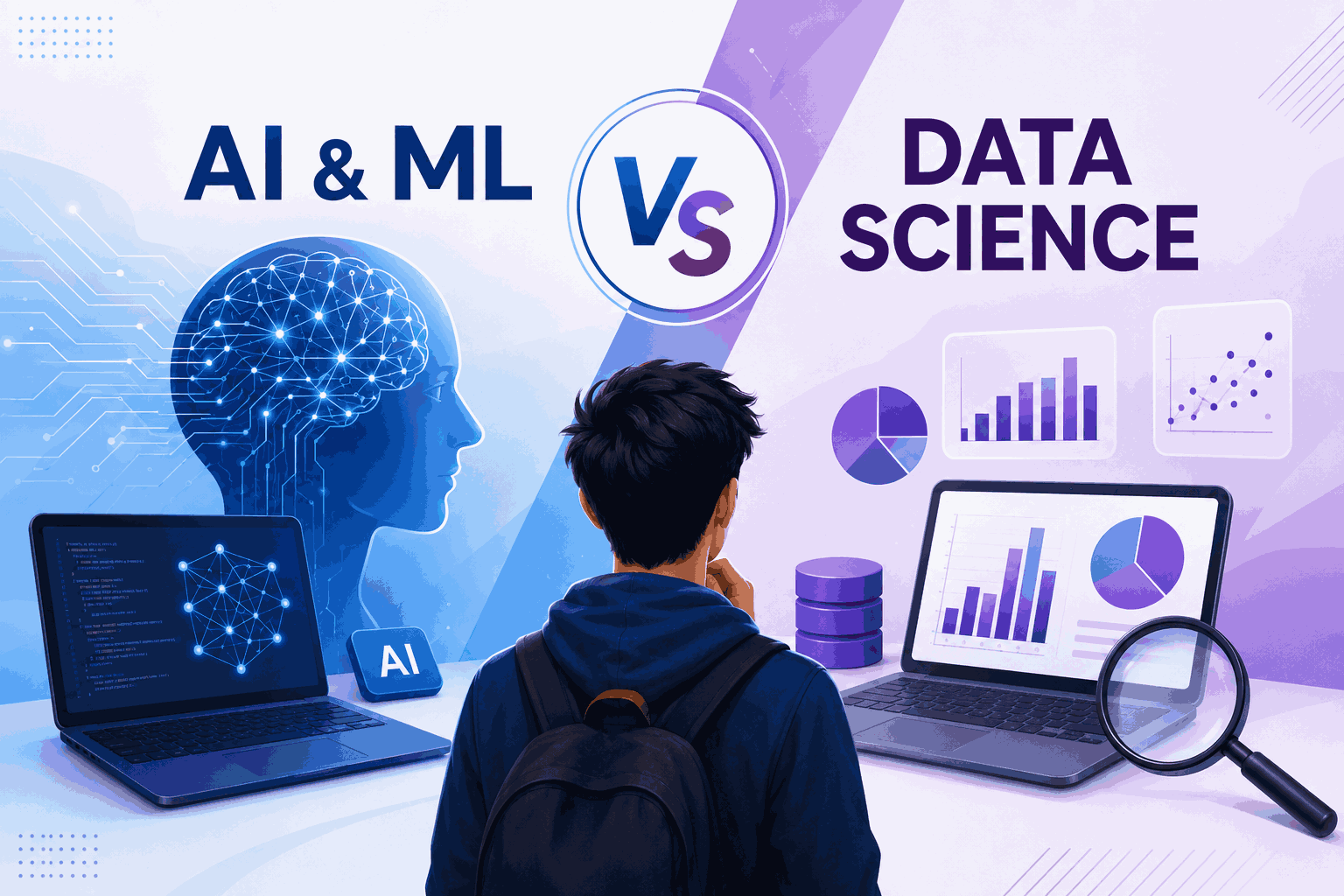
Choosing a technology course after Class 12 can feel confusing, especially when several programmes seem to lead to similar careers. AI & ML and Data Science are two fields that have gained a lot of attention in recent years. Both involve technology, programming, mathematics and data, but they are not exactly the same.
For students planning their careers in 2026, the real question is not simply, “Which course is more popular?” A better question is, “Which course matches my interests, strengths and career plans?”
Artificial Intelligence and Machine Learning are being used in areas such as healthcare, banking, manufacturing, e-commerce, transportation and software development. At the same time, businesses continue to depend on data to understand customers, improve operations and make better decisions. The World Economic Forum's Future of Jobs Report 2025 lists AI and Machine Learning Specialists and Big Data Specialists among the fastest-growing job roles towards 2030.
That makes both fields worth considering. However, the learning experience and career paths can be quite different.
AI & ML vs Data Science: What Is the Difference?
The easiest way to understand the difference is to look at what each field tries to achieve.
Artificial Intelligence and Machine Learning focus on making computers capable of learning from information and performing tasks that normally require human intelligence.
Data Science, on the other hand, focuses on understanding data and using it to find patterns, answer questions and support decisions.
There is some overlap between the two. Machine learning is actually used within Data Science, while AI systems often depend on large amounts of data. This is why students sometimes find it difficult to understand where one field ends and the other begins.
In the workplace, AI engineers, machine learning engineers, data scientists and data engineers may work together on the same project.
What Do Students Learn in AI & ML?
An AI & ML programme generally has a strong technical focus.
Depending on the college and curriculum, students may study subjects such as:
-
Programming
-
Data Structures and Algorithms
-
Mathematics
-
Probability and Statistics
-
Artificial Intelligence
-
Machine Learning
-
Deep Learning
-
Neural Networks
-
Computer Vision
-
Natural Language Processing
-
Data Handling
-
Model Development
Students may also work on projects involving recommendation systems, image recognition, chatbots, predictive models and other AI applications.
The field is a good fit for students who enjoy coding, problem-solving and understanding how intelligent systems work.
What Do Students Learn in Data Science?
Data Science has a slightly different approach.
Instead of focusing mainly on building intelligent systems, students learn how to work with data and extract useful information from it.
A Data Science curriculum may include:
-
Statistics
-
Mathematics
-
Python
-
Data Analysis
-
Database Management
-
Data Visualisation
-
Machine Learning
-
Data Mining
-
Predictive Analytics
-
Business Analytics
For example, imagine an online shopping company wants to understand why some customers stop buying from its platform.
A Data Scientist might analyse customer behaviour, purchase history and other information to identify patterns and help the company make better decisions.
So, if you enjoy working with numbers, finding patterns and answering questions through data, Data Science could be an interesting option.
AI & ML vs Data Science: Career Opportunities
This is where the comparison becomes more interesting.
Both fields offer different career paths, and neither should be treated as a guaranteed shortcut to a high-paying job.
Careers After AI & ML
Students with the right technical skills can explore roles such as:
-
Machine Learning Engineer
-
AI Engineer
-
AI Developer
-
Deep Learning Engineer
-
Computer Vision Engineer
-
NLP Engineer
-
Robotics Engineer
-
AI Researcher
The exact role depends on the student's skills, degree, projects and experience.
For example, someone interested in computer vision might work on systems that analyse images or videos. Another person may work on language-based AI applications.
Careers After Data Science
Data Science can lead to roles such as:
-
Data Scientist
-
Data Analyst
-
Business Intelligence Analyst
-
Data Engineer
-
Data Analytics Specialist
-
Product Analyst
-
Business Analyst
-
Machine Learning Specialist
The work can vary considerably between companies.
A Data Analyst may spend more time creating reports and dashboards, while a Data Scientist may build statistical or machine learning models.
This variety is one reason students should look carefully at the actual job description instead of judging a career only by its title.
Which Has Better Career Opportunities in 2026?
There is no simple winner.
The demand for both AI-related and data-related skills is growing. The World Economic Forum's 2025 report identifies AI and big data among the fastest-growing skill areas and expects AI and Machine Learning Specialists and Big Data Specialists to be among the fastest-growing roles through 2030.
So, rather than asking which field has more opportunities, students should ask which field offers the right opportunities for them.
For instance:
AI & ML may suit you if you want to:
-
Build intelligent applications
-
Work with machine learning models
-
Explore generative AI
-
Work with robotics or automation
-
Study deep learning
-
Develop computer vision systems
Data Science may suit you if you want to:
-
Analyse large datasets
-
Work with statistics
-
Find trends and patterns
-
Create data-driven reports
-
Help businesses make decisions
-
Work in analytics and predictive modelling
AI & ML vs Data Science: Which Is More Difficult?
This is another question students frequently ask.
The honest answer is that both can be challenging.
AI & ML can become technically demanding when students start learning neural networks, deep learning, optimisation and advanced machine learning algorithms.
Data Science can also be challenging because it involves statistics, probability, data cleaning, modelling and analytical thinking.
If mathematics is not your favourite subject, neither course should be selected without understanding the curriculum first.
At the same time, you do not need to be a mathematics expert before starting either course. A willingness to learn and practise matters more.
Which Course Requires More Coding?
Both courses involve programming.
Python is widely used in both AI/ML and Data Science.
However, the type of programming work can differ.
AI & ML students may spend more time building and testing machine learning models, implementing algorithms and developing AI-based applications.
Data Science students may use programming to clean data, analyse datasets, create visualisations and develop predictive models.
In both cases, learning only the basics of a programming language is unlikely to be enough. Students should gradually become comfortable with writing code and solving problems independently.
What Skills Matter Beyond the Degree?
One mistake students often make is thinking that the degree name alone will decide their career.
It won't.
A student studying AI & ML can still struggle to find the right opportunity without practical skills. The same applies to Data Science.
Students should try to build:
1. Programming Skills
Start with Python and develop strong programming fundamentals.
2. Problem-Solving Ability
Do not focus only on memorising syntax. Learn how to approach a problem and break it into smaller parts.
3. Statistics
A basic understanding of statistics is useful in both fields.
4. Data Handling
Learn how data is collected, stored, cleaned and analysed.
5. Project Experience
Build small projects instead of relying only on classroom assignments.
6. Communication Skills
Being able to explain a technical result in simple language is an underrated skill.
7. Continuous Learning
AI and data technologies change quickly. What students learn in first year may look different by the time they graduate.
The World Economic Forum also highlights analytical thinking, creative thinking, technological literacy and lifelong learning as important skills for the changing job market.
AI & ML vs Data Science: What About Higher Studies?
Both fields offer several options for further education.
After graduation, students can consider postgraduate programmes in:
-
Artificial Intelligence
-
Machine Learning
-
Data Science
-
Computer Science
-
Statistics
-
Business Analytics
-
Robotics
-
Information Technology
Students interested in research can also explore doctoral programmes.
Higher studies can be particularly useful for students who want to move into specialised technical or research-oriented careers.
How Should You Choose Between AI & ML and Data Science?
Instead of choosing based only on what is trending on social media, think about your own interests.
Ask yourself:
Do I enjoy coding and building things?
If yes, AI & ML may be worth exploring.
Do I enjoy numbers, statistics and finding patterns?
Data Science could be a better fit.
Am I interested in how machines learn?
AI & ML may be more suitable.
Do I enjoy using information to answer business or practical questions?
Data Science may appeal to you more.
There is no problem if you are interested in both. The two fields share many fundamentals, and professionals often move between related roles during their careers.
What Should You Check Before Choosing a College?
Once you have decided on a field, the next step is choosing a suitable programme and college.
Do not select a course only because the title contains words such as "AI", "ML" or "Data Science."
Look at the actual curriculum.
Check whether the programme includes:
-
Strong programming fundamentals
-
Mathematics and statistics
-
Practical laboratory work
-
Machine learning
-
Data analysis
-
Industry-relevant projects
-
Internships
-
Research opportunities
-
Technical clubs or competitions
It is also worth checking faculty profiles, infrastructure, placement information and the type of projects students have worked on.
Most importantly, compare information from official college sources rather than relying entirely on advertisements or third-party rankings.
AI & ML vs Data Science: A Simple Comparison
|
Factor |
AI & ML |
Data Science |
|
Main focus |
Intelligent systems |
Data analysis and insights |
|
Programming |
High importance |
High importance |
|
Statistics |
Important |
Very important |
|
Machine Learning |
Core area |
Important area |
|
Deep Learning |
Strong focus |
Optional/specialised |
|
Data Visualisation |
Useful |
Important |
|
Automation |
Strong connection |
Used in selected applications |
|
Suitable for |
AI and technology enthusiasts |
Data and analytics enthusiasts |
|
Career areas |
AI, ML, robotics, NLP, computer vision |
Analytics, data science, BI, data engineering |
Final Thoughts
The AI & ML vs Data Science comparison is likely to remain relevant as technology continues to influence different industries.
AI & ML offers exciting opportunities for students interested in intelligent systems, automation, machine learning and emerging technologies. Data Science provides a strong path for those who enjoy statistics, data analysis, business problems and finding useful insights from information.
Neither course guarantees a particular job or salary. What matters is what you do with the opportunity.
A student who learns beyond the syllabus, works on real projects, improves programming skills and stays curious about new technologies can build a strong foundation in either field.
So, if you are choosing a course in 2026, don't ask only “Which one has more scope?”
Ask yourself:
“Which type of work would I actually enjoy learning for the next four years?”
That answer may tell you more about the right course than any ranking or salary chart.