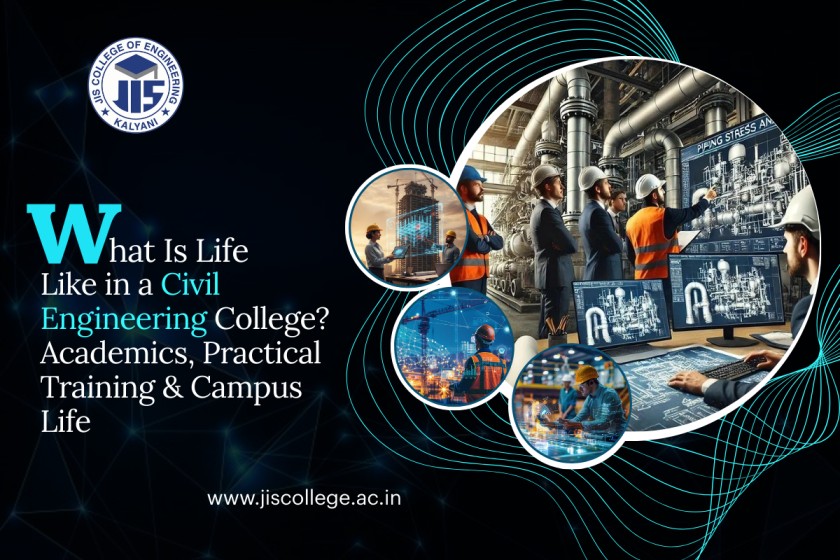
Academics, Practical Training & Campus Life Explained
Introduction: A Simple Question That Decides a Big Career
Have you ever looked at a flyover, metro line, or high-rise building and wondered, “Who actually designs and builds this?”
The answer is Civil Engineers—the backbone of modern infrastructure.
If you are a student planning your future, or a parent guiding your child, understanding life inside a civil engineering college is just as important as knowing the syllabus. From classrooms and construction labs to internships and campus life, this blog gives you a real, inside look at what studying civil engineering truly feels like—especially in the top civil engineering colleges in Kolkata, like JISCE.
What Do You Study in a Civil Engineering College?
Core Academics Explained Simply
Civil engineering academics focus on designing, constructing, and maintaining infrastructure such as buildings, bridges, roads, and water systems.
In B.Tech colleges for civil engineering, students typically study:
Year-wise Academic Structure
-
1st Year:
-
Engineering Mathematics
-
Physics & Chemistry
-
Basic Engineering Drawing
-
2nd–3rd Year:
-
Structural Analysis
-
Concrete Technology
-
Geotechnical Engineering
-
Fluid Mechanics
-
Final Year:
-
Transportation Engineering
-
Environmental Engineering
-
Major Project & Internships
At the Best Private Engineering College in Kolkata, West Bengal, theory is always supported by real-world problem solving, not rote learning.
Practical Training: Where Learning Becomes Real
Labs, Workshops & Field Visits
Civil engineering is not a desk-only profession. Practical exposure is the heart of the course.
At institutions like JISCE, students experience:
-
Concrete & material testing labs
-
Surveying using modern instruments
-
Software training (AutoCAD, STAAD, ETABS)
-
Industrial site visits (bridges, highways, buildings)
Example:
Students may visit a live construction site to understand how foundations are laid—something no textbook can fully explain.
Campus Life: Beyond Books & Blueprints
A Balanced Student Experience
Life in top civil engineering colleges in Kolkata is not just about academics. A vibrant campus life helps students grow personally and professionally.
Campus life usually includes:
-
Technical clubs (civil tech forums, innovation cells)
-
Cultural festivals & sports events
-
Guest lectures by industry professionals
-
Student-led competitions & hackathons
This balance ensures students graduate with confidence, teamwork, and leadership skills.
Pros & Cons of Studying Civil Engineering
|
Pros |
Cons |
|
Evergreen demand for infrastructure |
Requires strong fundamentals |
|
Hands-on practical learning |
Initial fieldwork can be demanding |
|
Government & private job opportunities |
Project deadlines can be tight |
|
Global career scope |
Continuous skill upgrades needed |
Step-by-Step: How a Civil Engineering Student Grows
-
Build Fundamentals – Mathematics, physics, materials
-
Learn Tools – Design software & lab instruments
-
Apply Knowledge – Internships & live projects
-
Specialise – Structures, construction, environment
-
Enter Industry / Higher Studies – Jobs, M.Tech, MBA, PSU exams
Career Scope After Civil Engineering
Where Can You Work?
Graduates from B.Tech colleges for civil engineering can explore roles such as:
-
Site Engineer
-
Structural Design Engineer
-
Project Manager
-
Government Engineer (PWD, Railways, PSU)
-
Urban Planner
-
Construction Consultant
Salary Insights (India – Approx.)
-
Fresh Graduate: ₹3–5 LPA
-
With 5+ years experience: ₹8–12 LPA
-
Specialised roles / Overseas: ₹15+ LPA
Source: NASSCOM & AICTE career reports
Future Trends in Civil Engineering (2025 & Beyond)
Civil engineering is evolving with technology.
Emerging Trends:
-
Smart cities & sustainable construction
-
Green buildings & renewable materials
-
AI & BIM (Building Information Modelling)
-
Disaster-resistant structures
Colleges like JISCE focus on future-ready skills, keeping students industry-aligned.
Top Skills Required to Succeed in Civil Engineering
Technical Skills
-
Structural analysis
-
AutoCAD & design tools
-
Construction planning
Soft Skills
-
Problem-solving
-
Communication
-
Team coordination
How to Get Started?
-
Choose a reputed college with strong labs
-
Take internships seriously
-
Learn industry software early
-
Participate in technical competitions
Why Students Choose Top Civil Engineering Colleges in Kolkata
-
Strong academic foundation
-
Affordable education compared to metros
-
Growing infrastructure projects in East India
-
Exposure to both public & private sector opportunities
The Best Private Engineering College in Kolkata, West Bengal offers a blend of quality education, industry exposure, and student support.
FAQs: Common Questions Answered Simply
1. Is civil engineering difficult for beginners?
Not if you understand concepts step by step and practice regularly.
2. Does civil engineering require site work?
Yes, but many roles also focus on design and planning.
3. Can I get a government job after civil engineering?
Yes. Many graduates prepare for PSU, SSC, and state exams.
4. Which is better: civil or computer engineering?
Both are good—choose based on interest, not trends.
5. Are private colleges good for civil engineering?
Yes, if they have strong labs, faculty, and training support.
6. What is the future of civil engineering in India?
Very strong due to urbanisation, infrastructure growth, and smart cities.
Conclusion: Is Civil Engineering the Right Choice for You?
Life in a civil engineering college is challenging, practical, and deeply rewarding. From designing real structures to contributing to national development, the journey shapes you into a problem-solver and leader.
If you are looking for top civil engineering colleges in Kolkata that offer academic excellence, hands-on training, and holistic campus life, JISCE stands as a strong choice.
Take the next step:
Explore the Civil Engineering program at JIS College of Engineering, connect with counselors, or apply today to build a future that stands strong—just like the structures you’ll design.